Every clinic needs a reliable way to communicate with patients, route calls, share information internally, and manage multiple providers without losing track of who needs what.
For years, traditional PBX systems were the standard medical phone system in practices of every size. They worked, they were familiar, and they got the job done. But technology has moved quickly, and the pressure to deliver faster access, clearer communication, and better clinical alignment has pushed many clinics to rethink their approach.
That shift has opened the door to cloud-based VoIP systems built specifically for cloud-native healthcare communication. These platforms support HIPAA compliance, automated routing, multi-site visibility, and clinical workflow alignment that a PBX just can’t match. As practices grow, expand locations, add specialties, or integrate telehealth, the gap widens even more.
Below is a breakdown of what each option offers, where each one falls short, and why the right medical phone system can change how a clinic operates.
How Traditional PBX Systems Work
A PBX system is a hardware-based setup that manages phone lines inside the office. It lives physically in the clinic, with wiring that connects handsets and lines throughout the building. It’s purchased upfront and maintained by a vendor or internal IT team.
Many clinics still prefer PBX because of its stability. The system rarely goes offline, and call quality is usually strong. There’s no internet dependency, and the setup is simple for staff who don’t want to relearn new processes.
But these strengths are paired with trade-offs. The system doesn’t adapt well when clinics grow. Adding new locations, providers, or workflows becomes expensive and technically messy. Integrations are minimal. Reporting is limited. Data is fragmented. PBX was designed for basic phone calls, not a digital patient experience.
How Cloud VoIP Systems Work
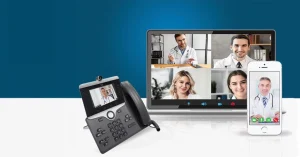
A cloud-based phone system for medical practice use runs through secure internet connections instead of hardware wiring. Clinics can update, expand, or modify the system without replacing hardware. A laptop, headset, or mobile device can function as a phone, and call routing updates take seconds.
Modern VoIP platforms are built for today’s medical operations. Schedules, voicemail, analytics, and routing rules live in one secure platform instead of being scattered across tools. For providers working remotely or taking after-hours calls, everything is visible from anywhere and fully encrypted.
That flexibility is why VoIP adoption continues to accelerate across healthcare—especially in multi-site practices that depend on unified systems.
Pros and Cons of Traditional PBX
Traditional PBX systems offer predictability. Once installed, there isn’t much to think about. However, the comfort comes at a cost.
Advantages of PBX:
- Reliable in-office call quality
- Minimal day-to-day troubleshooting
- Familiar handset-based workflows
Challenges of PBX:
- High upfront investment and ongoing maintenance costs
- No native EMR integration
- Limited analytics or reporting
- Hard to scale across multiple locations
- No remote flexibility
For clinics running only one site with low call volume and no need for advanced routing or reporting, PBX can still be workable. For everyone else, the system becomes a limitation.
Pros and Cons of Cloud VoIP
Cloud VoIP platforms are built for dynamic clinic environments. They align communication with clinical operations instead of treating calls as isolated events.
VoIP Advantages:
- Lower upfront costs
- Lower monthly fees
- Fast setup and expansion
- Flexible device options
- Remote access for on-call providers
- Strong analytics and reporting
- Better routing for complex workflows
- HIPAA compliance baked in
VoIP Challenges:
- Dependent on internet stability
- Staff training required
- Culture shift away from desk phones
For most practices, the pros outweigh the drawbacks. The flexibility alone is transformative, especially when providers move between exam rooms, departments, home offices, and on-call shifts.
Why Modern Clinics Are Switching
Cloud VoIP platforms bring capabilities that go far beyond voice calls. A medical practice phone system with voicemail transcription and EMR integration helps teams close communication loops faster and document patient interactions accurately. That reduces friction between clinical, administrative, and billing workflows.
As medical groups turn to digital scheduling, telehealth, and remote staffing, cloud systems create a consistent experience that PBX can’t replicate. For practices managing multiple locations, a cloud medical phone system scaling multiple clinic locations eliminates complexity by pulling every line, message, voicemail, fax, and schedule into one platform.
That creates a single source of truth instead of a patchwork of devices and processes.
Why a Medical Phone System Matters Now
Healthcare organizations are dealing with rising call volume, tighter documentation requirements, and higher expectations from patients. Clinics need tools that help staff communicate clearly without pulling them away from care. The best medical phone system is the one that gives providers more control, not more clutter.
Doctoc brings that control together. It acts as a secure patient communication system for medical offices, connecting calls, messages, routing, voicemail, alerts, and analytics in one cloud environment. Because it supports cloud native healthcare communication, practices can scale communication workflows the same way they scale clinical services.
Doctoc gives healthcare organizations a decisive edge in telehealth, remote care coordination, and multi-site clinic management. It’s designed to improve access, clarity, and control.
With features such as secure messaging, automated call routing, voicemail-to-text, real-time analytics, and seamless EMR integrations, Doctoc delivers a modern communication experience that traditional PBX systems simply cannot match. By combining reliability with workflow intelligence, we help clinics streamline operations, reduce missed connections, and elevate patient engagement across every touchpoint.
Many clinics pair VoIP with a patient engagement platform or clinical workflow integration strategy to strengthen the loop between communication and care delivery. Some are even using inpatient workflow automation using collaboration software to improve on-call response times and reduce administrative bottlenecks.
The result is less waste, clearer documentation, fewer missed messages, and a better patient experience from the first phone call forward.
FAQs
1. What is the biggest difference between PBX and VoIP?
PBX uses in-office hardware and wiring. VoIP runs through secure cloud connections. VoIP is more flexible, scalable, and cost-effective for medical practices.
2. Are VoIP systems secure enough for healthcare?
Yes. A HIPAA-compliant VoIP medical phone system protects PHI through encryption, role-based access, and secure data routing.
3. Can VoIP handle multiple clinic sites?
Yes. VoIP easily manages multiple locations in one unified system without installing new hardware or wiring.
4. Does VoIP improve patient access?
It can. Automated routing, voicemail transcription, and remote visibility make it easier for patients to reach the right provider faster.
5. Does VoIP reduce costs compared to PBX?
Most clinics save 30–70% by switching to VoIP because they eliminate hardware fees, wiring upgrades, and high per-line billing.
6. Will staff need new training?
A small learning curve is normal, but most teams adjust quickly because the system is accessible, intuitive, and mobile-friendly.